
Detroit’s Housing Accessibility Crisis in Data
April 14, 2026
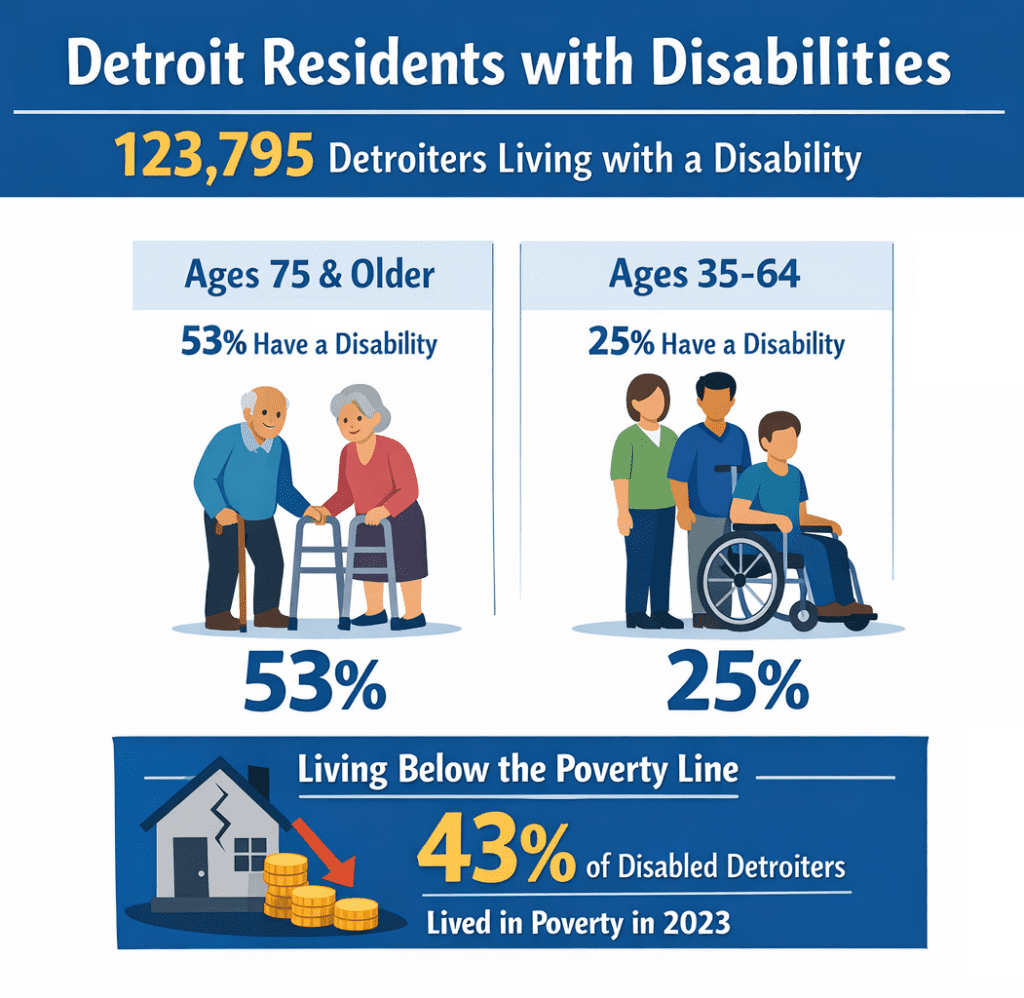
Approximately 1 in 5 Detroit resident’s lives with a disability; they are living in housing that was never designed to meet their needs. In August 2025, the City of Detroit’s Housing and Revitalization Department (HRD), in partnership with Detroit Disability Power, released a comprehensive report on housing accessibility in Detroit. This post breaks down the key findings, connects them to what we’ve seen play out in real time at City Council, and shares what Detroit can — and must — do differently.
Source: “Housing Accessibility: Needs & Opportunities in Detroit” by the Housing & Revitalization Department’s (HRD) Policy Development & Implementation Division. Published August 2025.
Who We’re Talking About
The most common disabilities among Detroiters are ambulatory difficulties (serious trouble walking or climbing stairs), cognitive difficulties, and independent living difficulties. Nearly 69,000 Detroiters live with ambulatory disabilities alone—an important distinction as these are people for whom inaccessible housing is not a minor inconvenience — it is a daily safety risk.
Employment and wages compound the problem. Only 19% of disabled Detroiters 16+ are employed. Median earnings for a disabled resident in 2023 were $23,405, compared to $32,712 for a nondisabled resident. On a fixed income, housing is not just a comfort issue — it is an economic survival issue.
A Structural Housing Stock Problem
Here is the core of the problem: more than 93% of Detroit’s housing stock was built before 1990 — before modern federal accessibility requirements took effect. The Fair Housing Act’s accessibility mandates apply to buildings built for first occupancy after March 1991. That covers only 6.7% of Detroit’s existing housing. The other 238,689 units were built in an era when accessibility was simply not part of the design conversation.
Even within the newer, city-funded affordable housing portfolio (~10,216 units built post-1991) the estimates are sobering. Only about 511 units are estimated to be accessible for people with mobility disabilities. Only about 204 are accessible for those with hearing or visual disabilities. Similarly, across the U.S., fewer than 4% of homes meet the three core features of accessible housing: single-floor living, no-step entries, and wide hallways and doorways.
Detroit’s housing market makes this worse. Home prices rose 27.3% in a single year (November 2023 to November 2024), far outpacing the typical 2% growth seen in stabilized markets. The median gross rent (2019-2023) was $1,034 per month, while the median annual income for a Detroit resident was $36,140. For a disabled resident earning $23,405 a year, that math is impossible. And over the past 20 years, even through Detroit’s much-celebrated revitalization, homeownership has declined. Notably, renters now outnumber owners, and 39,000 fewer households own their homes.
Resident Experience
HRD commissioned resident surveys, listening sessions, and stakeholder interviews to understand the lived experience behind the numbers. The qualitative findings reflected the housing data:
- 50%+ of disabled residents said their home does not meet their accessibility needs.
- ~70% said getting in and out of the bathtub or shower is difficult because of their disability.
- 60% of respondents reported having more than one disability — underscoring the need for flexible, adaptable design rather than one-size-fits-all solutions.
- About 48% said reaching kitchen cabinets or the refrigerator is difficult. The most needed features include roll-in showers, grab bars, and comfort-height toilets.
- 70% of those who couldn’t find accessible housing said they simply could not afford it. Long waitlists, high application fees, and low credit scores created additional barriers.
Caregivers are also struggling. Often an invisible group in both policy and family response discussions, 50%+ reported feeling “very or somewhat unsupported” in their roles. The top resources they said would make the biggest difference: home modifications, assistive technology, and financial assistance.
On the property management side, interviews revealed another problem: accessible units are not always occupied by residents with disabilities. In some cases, there is low demand because disabled residents don’t know the units exist. In others, the leasing process fails to prioritize disabled applicants. Across Michigan, data from major housing organizations shows that fewer than half of accessible units are occupied by residents who need them.
The Leland House — A Case Study in What Happens When the System Fails
The Leland House apartment building crisis, which dominated Detroit City Council sessions in February 2026, is not just a landlord accountability story. It is a housing accessibility story.
The building had been out of compliance since 2022 for issues around electricity, heat, elevator access, rodents, mold, and standing water. BSEED (Buildings, Safety Engineering, and Environmental Department) had a consent agreement with the owners for nearly two years, and enforcement was insufficient. When DTE cut power over unpaid bills and the transformer broke winter 2025, dozens of residents were displaced immediately g. They couldn’t get their belongings out because there was no electricity, no working elevator, and the building was declared unsafe.
Many of those residents were seniors and people with disabilities. For them, sudden displacement from a building with no working elevator is not just an inconvenience — it is a health crisis. Without access to their belongings, many lost their jobs. As residents had no access to the building, reports of break-ins and theft included lost cash, clothing, and medical equipment. Some had to file for bankruptcy.
When enforcement is reactive rather than proactive, people suffer. The Leland House situation is a preview of what happens when accessibility is treated as an afterthought rather than a baseline requirement.
Housing Law’s
Housing accessibility is governed mainly by two other laws: the Fair Housing Act and Section 504 of the Rehabilitation Act.
- The Fair Housing Act prohibits housing discrimination and requires basic accessibility in buildings with four or more units built after March 1991 — but it only requires ground-floor accessibility in buildings without elevators, and its standards are modest minimums.
- Section 504 of the Rehabilitation Act requires that federally-assisted new housing have 5% of units accessible for people with mobility disabilities, and 2% for those with hearing or visual disabilities. In a 40-unit building, that means just two accessible units.
If 20% of Detroit’s population has a disability, and only 5% of federally-funded units are required to be accessible, the gap is enormous. Detroit’s HRD has tried to close it by requiring 10% accessibility in new construction receiving city funds — double the federal minimum — and awarding bonus points to developments that go to 15%. That is a meaningful step. But it is not enough on its own, and it only applies to publicly funded projects.
What Detroit Can Learn From Other Cities
Communities across the country are grappling with the same challenge, and some have found approaches worth studying:
- Los Angeles awards 10 bonus points in housing funding applications for developments that incorporate enhanced accessibility features.
- Toronto updated its Affordable Rental Housing Design Guidelines in 2024. Research indicates that it costs 7.7 times more to retrofit accessibility into existing buildings than to design it in from the start.
- Alameda, CA passed a Universal Design ordinance requiring 100% of new developments with 5+ units to be visitable, and 30% to be fully habitable by residents with mobility challenges.
- New York City runs a housing lottery for accessible units — only disabled residents receive a number for that lottery, ensuring accessible units are matched to residents who need them.
- Chicago and Pittsburgh both operate city funds to help low-income residents with disabilities pay for accessibility modifications to their rental units.
- Grand Rapids reformed its zoning code to allow accessory dwelling units, small-scale single-room occupancy homes, and reduced parking requirements — changes that lower the cost of building accessible housing.
Detroit’s Right to Counsel Ordinance, passed in 2022, has also shown meaningful results for disabled residents. From the 344 disabled households assisted, all of them retained their housing subsidies, and none were evicted.
Need Steps
The HRD report recommended next steps that included:
- Continue requiring 10% accessible units (double the federal minimum) in city-funded developments.
- HRD is attempting to launch a city fund for renters who need financial assistance to implement accessibility modifications.
- Launch the Critical Home Repair Program to cover accessibility-related repairs for homeowners with urgent health and safety needs.
- Create a centralized, accurate database of accessible housing units across the city.
- Standardize how property managers handle accommodation and modification requests. The current system is confusing and places residents who don’t know their rights at a disadvantage.
- Distribute educational materials to residents, developers, and property managers about accessibility laws and best practices. Detroit Disability Power is already leading this initiative.
Upcoming Event!
If this topic interests you, there is a free upcoming event that connects the history of housing policy to where Detroit finds itself today:
🏠 History of Housing & Urban Policy in Detroit 🏠
Lunch-and-Learn Webinar for Fair Housing Month
Speaker: Dr. Timothy Robinson, Veteran Affairs
Date & Time: 🕚 Wednesday, April 15 from Noon – 1:00 PM 🕚
Location: 📍 Zoom link: https://cityofdetroit.zoom.us/j/88630558799 | Meeting ID: 886 3055 8799 📍
Dr. Robinson will trace the history of housing discrimination in America and how those patterns specifically shaped — and continue to shape — Detroit. From the turn of the century to today, this session details the disproportionate impacts of policy on who gets access to housing and who doesn’t. The event will be recorded and made available as a webinar.
To register or learn more, visit: https://tinyurl.com/ODAEventRegistration
I’ll continue tracking this issue as HRD’s programs roll out. If you have questions, resources to share, or want to get involved, reach out.
Khurram Imam is the Director of Zaki Impact Consulting, where he helps governments, nonprofits, and foundations design strategies and programs that are equitable, measurable, and built to last. His work sits at the intersection of public health, workforce development, and community systems. Connect with him on LinkedIn or explore his services at khurramimam.com/services.
